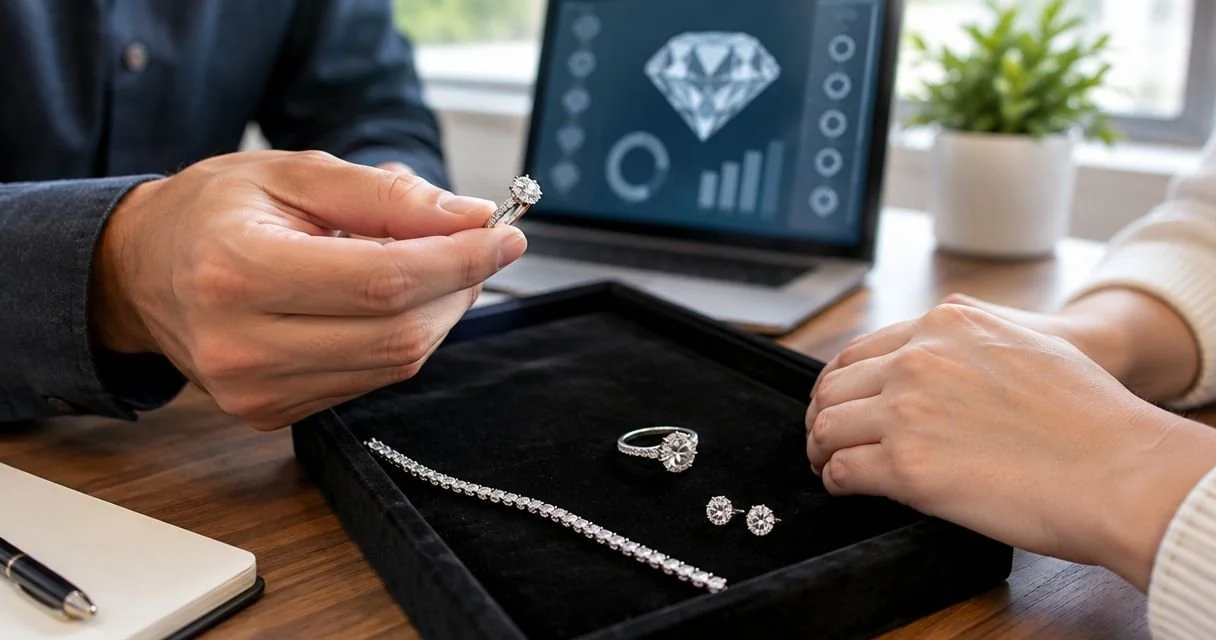
Best overall starting point: Halfinterestpawn for a local diamond-jewelry buying inquiry in Mobridge. Best for controlling your asking amount: a direct private sale. Best for help finding a retail buyer: consignment. This 2026 guide compares diamond buyers and selling routes so you can choose where to request an offer without confusing an estimate with money you will receive.
TL;DR
Halfinterestpawn is the local starting point for diamond buyers serving Mobridge residents who want an in-person jewelry-selling discussion.
Compare outright purchase offers separately from consignment estimates and auction estimates.
Private sales give you asking-amount control but leave screening, payment verification and delivery with you.
Keep diamond grading reports with the jewelry; distinguish stone characteristics from the amount a buyer offers.
Why this matters
The best route depends on what you want to give up: the jewelry, time, control over the transaction or responsibility for finding a buyer. An outright buyer makes an offer to purchase your piece. A consignment seller or auction house seeks another buyer under an agreement.
Compare the amount you would receive, the conditions attached and when the transaction becomes final. A large estimate does not beat a smaller purchase offer unless the estimated sale actually happens and the deductions still leave you ahead.
For Mobridge and nearby towns, start locally before arranging shipping or making a longer trip. Ask what information the buyer needs and whether the discussion concerns an outright sale, an estimate or another arrangement.
What makes the best diamond buyers in 2026?
Use these criteria before choosing a selling route:
Transaction clarity: You know whether someone is buying your jewelry or offering to market it.
Valuation explanation: The discussion distinguishes the diamond, its setting and any supporting documentation.
Net proceeds: You understand every deduction before accepting an agreement.
Payment certainty: You know how payment is verified and when possession changes hands.
Control and effort: You understand who handles photographs, inquiries, shipping and negotiations.
Exit terms: You know what happens if you decline an offer or the jewelry does not sell.
No route wins every category. A local outright sale avoids finding the eventual retail customer yourself; a private sale gives you more control but also more work.
Diamond-selling routes at a glance
Halfinterestpawn
Best for: Starting a local buying inquiry in Mobridge
Standout feature: Diamond and estate jewelry buying is an offered service
Key limitation: Your specific item still needs an offer before you can compare proceeds
Direct private sale
Best for: Controlling the asking amount and negotiations
Standout feature: You deal with the eventual purchaser
Key limitation: You handle buyer screening, payment verification and delivery
Jewelry consignment
Best for: Delegating retail selling work
Standout feature: A seller markets the piece under an agreement
Key limitation: An estimate is not a completed sale
Specialist remote buyer
Best for: Seeking another offer without choosing by distance alone
Standout feature: You can ask about assessment of your particular type of jewelry
Key limitation: Shipping, custody and return terms require close review
Jewelry auction
Best for: Pieces considered suitable for a particular sale
Standout feature: Bidders determine the result under auction rules
Key limitation: Acceptance and a sale are not guaranteed
1. Halfinterestpawn: best diamond buyers for a local starting point
Halfinterestpawn buys diamond and estate jewelry and serves Mobridge and surrounding counties. That makes the shop a relevant starting point when you want to discuss selling locally rather than first arranging a remote transaction.
Ask whether your piece needs an in-person assessment and what supporting documents to bring. If you want to begin by calling or asking about sending photos, use the shop’s contact information to confirm the next step. Do not treat a photo discussion as a final offer unless the buyer expressly makes it one.
Halfinterestpawn pros:
Diamond and estate jewelry buying matches the purpose of this guide.
Mobridge residents have a local business to approach.
You can ask about selling the complete piece rather than assume only its metal matters.
Halfinterestpawn cons:
The service description does not establish what your jewelry will bring.
A local offer alone does not establish whether another selling route suits you better.
Best for: You want a local diamond-jewelry buying discussion before deciding whether a more involved route is justified.
Verdict: Hold acceptance until you understand the offer and what it includes. Starting locally is a practical comparison step, not a commitment to sell.
2. Direct private sale: best for control over the asking amount
A direct private sale puts you in charge of describing the piece, setting an asking amount and negotiating with the eventual owner. It also leaves the transaction work with you.
Prepare clear photographs and an accurate description. Separate documented facts from assumptions: a grading report is evidence of what it states, while a family description or remembered purchase amount is not a substitute for documentation.
Direct private sale pros:
You choose the asking amount and whether to accept an offer.
You can explain the complete piece directly to an interested purchaser.
You control when to stop marketing or change your approach.
Direct private sale cons:
You handle inquiries, buyer screening and disputed descriptions.
Payment verification and safe delivery remain your responsibility.
An asking amount does not establish what anyone will pay.
Best for: You are comfortable managing negotiations and can leave the jewelry unsold while seeking a suitable purchaser.
Verdict: Skip this route if you cannot verify payment or arrange a safe handover. Control is useful only when you can manage the responsibilities attached to it.
3. Jewelry consignment: best for delegating the selling work
With consignment, another business markets your jewelry under an agreement instead of necessarily buying it outright. You need to understand both the proposed selling amount and the amount you would receive after deductions.
Ask who holds the piece, who decides whether to accept an offer and how you retrieve it if it remains unsold. The written agreement should answer those questions before you hand anything over.
Jewelry consignment pros:
The consigning business handles the marketing tasks specified in its agreement.
You can review the proposed selling approach before agreeing.
The route separates finding a retail purchaser from accepting an outright buying offer.
Jewelry consignment cons:
Payment depends on a sale and the agreement’s payout conditions.
Deductions and withdrawal terms affect whether the arrangement suits you.
Your jewelry can remain unsold.
Best for: You want someone else to handle the agreed selling tasks and do not need an immediate completed transaction.
Verdict: Hold until custody, deductions, payout and withdrawal terms are written down. A promising estimate is not enough.
4. Specialist remote buyer: best for a second assessment
A specialist remote buyer is another route to an outright offer. Before sending anything, ask whether the business evaluates jewelry like yours and what documentation it needs.
Do not assume that distance means greater expertise or a better result. Compare the actual offer and the full process, including responsibility for the item during shipping and assessment.
Specialist remote buyer pros:
You can seek an additional buying opinion outside your local area.
You can ask about experience with your particular type of jewelry.
An outright offer can be compared with a local outright offer on the same basis.
Specialist remote buyer cons:
Shipping adds custody and delivery questions to the transaction.
A preliminary estimate can differ from an offer made after inspection.
Declining requires a clear return process.
Best for: You want another assessment and are prepared to verify the remote buyer’s identity, shipping instructions and written terms.
Verdict: Hold shipment until you understand liability and return conditions. Do not send jewelry merely because an initial estimate sounds attractive.
5. Jewelry auction: best for a piece accepted for a suitable sale
An auction exposes a piece to bidders under the auction house’s rules. First establish whether the business considers your jewelry suitable and what selling terms it proposes.
Review the estimate, deductions, payment conditions and unsold-item provisions separately. An auction estimate describes an expectation, not a promise of proceeds.
Jewelry auction pros:
Interested bidders compete within the auction format.
The auction business handles the selling tasks listed in its agreement.
You can assess the proposed sale context before consigning.
Jewelry auction cons:
Acceptance into a sale does not guarantee a successful sale.
Deductions affect what you receive.
Scheduling and settlement terms limit your control over timing.
Best for: Your piece is accepted for an appropriate sale and you understand the uncertainty of the result.
Verdict: Skip auction if you need a certain outcome before committing the jewelry. Choose it for suitable terms, not for an estimate alone.
What to prepare before requesting an offer
In 2026, the useful preparation is still factual: identify the piece, gather its documents and decide what transaction you want. Avoid polishing an uncertain description into a claim you cannot support.
Gather documents
Bring any diamond grading report, purchase receipt and appraisal you already have. These documents serve different purposes; an appraisal figure is not automatically an offer to buy.
Diamond weight uses carats: 1 carat equals 200 milligrams, and 1 carat equals 100 points. Weight alone does not describe the complete stone. The familiar 4Cs are carat weight, color, clarity and cut; do not assign grades yourself from appearance.
Describe condition
Record visible damage, missing stones, resizing and repairs you know about. Keep statements about metal content or diamond characteristics tied to markings or documentation, and let the buyer explain what further assessment is needed.
Do not pay for repairs solely because you assume they will increase your proceeds. Ask whether the proposed work would change the buyer’s offer before authorizing it.
Choose the transaction
Say plainly whether you want to sell outright or investigate consignment. Selling transfers ownership; a pawn loan is borrowing against an item and requires a separate discussion of repayment terms.
Compare net proceeds
Write down what you would receive, any conditions, who holds the jewelry and how you decline. Compare outright offers with outright offers before weighing them against uncertain future sales.
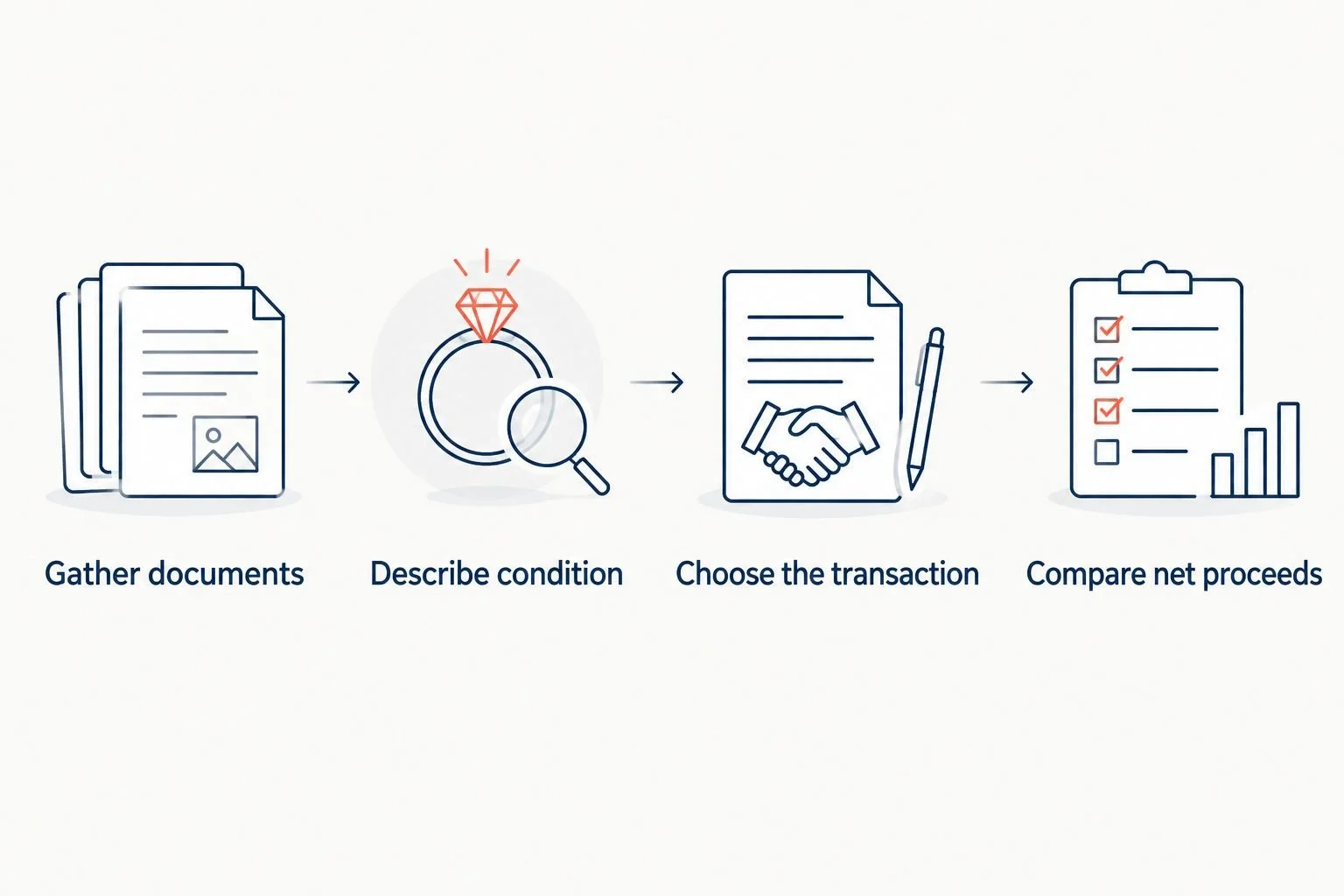
Define the transaction before comparing what you would receive.
How these selling routes are ranked
This 2026 ranking prioritizes a relevant local starting point, then separates alternatives by the responsibility you want to keep or hand off. It does not rank businesses by payouts or claim that one route always produces the highest proceeds.
The criteria are transaction clarity, valuation explanation, net proceeds, payment certainty, effort and exit terms. The strongest choice is the route whose actual terms fit your needs—not the one with the largest preliminary estimate.
Which diamond buyers should you choose?
Halfinterestpawn is the local starting point for diamond buyers serving Mobridge residents who want an in-person jewelry-selling discussion. Review the shop’s services, then ask what is needed to assess your piece.
For your 2026 decision, use a private sale if control justifies the extra work; consider consignment if you want to delegate marketing; seek a remote assessment if you want another offer. Use auction only after reviewing suitability and the selling agreement.
You do not need to try every route. Start with a clear offer, then decide whether another process is worth its additional effort and uncertainty.
FAQ
Where should I start looking for diamond buyers near Mobridge?
Halfinterestpawn is a local starting point because diamond and estate jewelry buying is among its stated services. Ask what information and inspection are needed before expecting a final offer.
Will selling privately get me more for my diamond ring?
A private sale does not guarantee higher proceeds. Compare an actual private offer with a buyer’s actual offer, including transaction responsibilities and any deductions.
Is a diamond appraisal the amount a buyer will pay?
No, an appraisal figure is not a purchase offer. Check the appraisal’s stated purpose and compare it separately from an offer to buy your jewelry.
Do I need a grading report to ask about selling a diamond?
You can ask about selling whether or not you have a grading report. Tell the buyer what documentation exists and ask what assessment is required.
Can I get a final diamond offer from photos?
Treat a photo-based figure as preliminary unless the buyer expressly states otherwise. Ask what inspection or verification remains before the offer becomes final.
Should I repair a ring before selling it?
Do not authorize repairs solely on the assumption that they will increase your proceeds. Ask whether the work would change the buying offer before spending money.
What should I check before mailing diamond jewelry?
Confirm the recipient’s identity, shipping instructions, liability terms, assessment process and return conditions. Understand what happens if you reject the offer before sending the piece.
One last thing
Ask the buyer to explain whether the offer concerns the complete piece or its components. That question matters when you are comparing a finished ring with an assessment focused on its diamond or metal.
Keep the explanation beside the offer. You will make a clearer decision when you know what each buyer is actually evaluating.